

What it costs
What does a new floor cost in San Diego?
Epoxy garage floors start from $5 a square foot, and the slab decides the rest. Here is exactly what moves a number up or down, so that when you get quotes, ours or anyone’s, you know what you’re reading. Then we measure your floor for free and give you a firm number in writing.
Straight answer
Why $5 a foot is where we start, not your price.
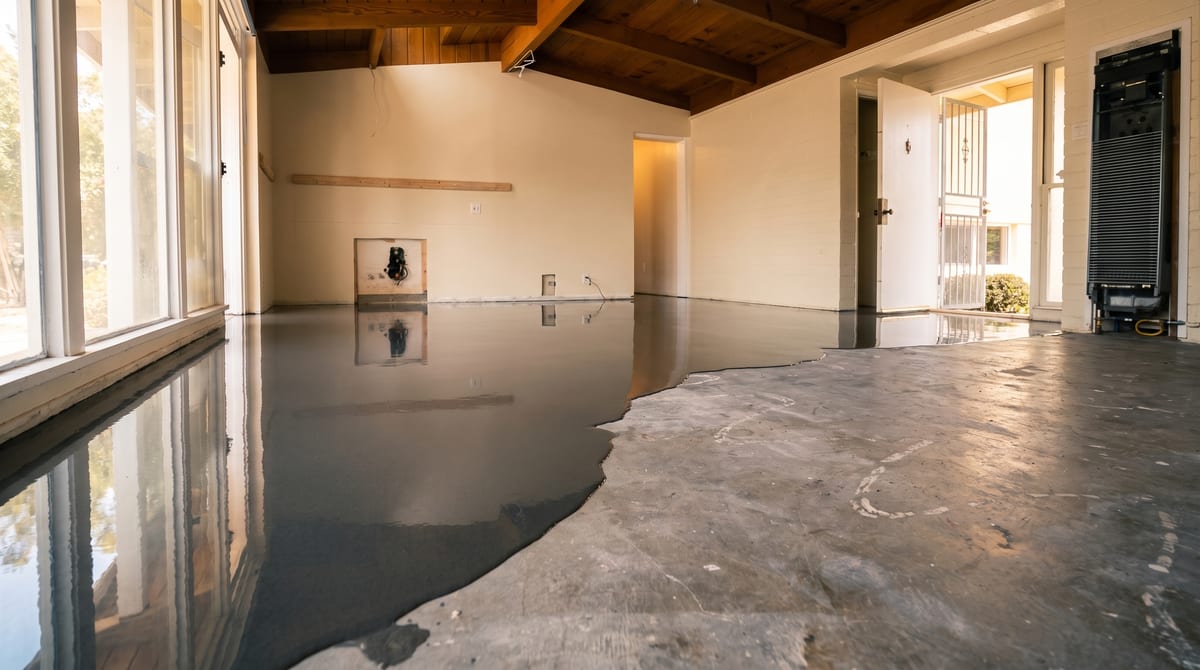
Because the slab decides the rest. $5 a square foot is where an epoxy garage floor starts, and the three things that move a floor quote most (what's under the coating, what the moisture reading says, and how much of it is stairs) are all invisible until somebody stands in the room. So the starting rate is here, and your real number comes at the visit, firm and in writing. LVP and hardwood have no starting rate yet; those are quoted at the visit too.

What you get instead
A firm number, in writing, at no charge.
We come to you anywhere in San Diego County, measure the space, look at the slab, bring real samples of whichever systems suit the room, and give you a number that holds. No charge for the visit and no obligation to book at the end of it.
We’re a service-area business, so there’s no showroom to drive to. The samples come to you.
Book the free measureThe seven
What moves the number.
Every one of these comes up at the quote visit, and every one of them is something you can look at yourself before we arrive.
| What changes | What it does to the number, and why |
|---|---|
| How big the floor is | The base of every quote, and the one people guess right. Bigger floors cost more in total and usually less per foot, because setup, grinding and cleanup are a fixed cost spread over more area. |
| What the slab is like underneath | We diamond-grind every slab and never acid-etch, so a bare, sound slab is the straightforward case. A slab that has been sealed, painted or coated before has to have that removed first, and that is real time. |
| Cracks, pits and spalls | Filled and ground flush before anything goes on. We find them and flag them at the quote visit rather than after, which is why the number you are given holds. |
| A moisture reading that fails | Concrete that is pushing moisture up through the slab will lift a coating off it. If a reading fails, it needs remediation before the floor goes down, and that is the single largest thing that moves a garage number. |
| Stairs | Every tread and riser is cut, fitted and finished by hand. A staircase is the most labour per square foot in an LVP or hardwood job, and a flight of stairs costs more than the landing it arrives at. |
| Furniture and appliances | Somebody has to move it out and put it back. If you clear the room yourself that comes off the number; if a gas range or a stacked washer needs disconnecting, that goes on it. |
| Which system, and which finish | Epoxy, LVP and engineered hardwood are three different jobs, not three prices for one job. Within epoxy, a solid colour is the most straightforward and metallic the most involved. |
Cure times and warranty by system are on the epoxy, LVP and hardwood pages.
Before you sign anything
How to compare two flooring quotes.
Two numbers for the same garage can differ by half and both be honest, because they are quoting different work. These are the six questions that tell you which is which.
01 Ask what the prep actually is
This is the biggest hidden difference between two epoxy quotes. Diamond grinding opens the concrete so the primer can key into it. An acid etch is cheaper and faster and is the usual reason a coating peels in a couple of years. Ask which one the number covers.
02 Count the coats, not the price per foot
Ask how many coats are in the quote and what the topcoat is. A primer, a pigmented base and a clear UV-stable topcoat is a floor. A single roll-on coat over untouched concrete is a paint job that will look identical for about a year.
03 Check whether crack repair is in the number or excluded
A quote that excludes crack and spall repair is not comparable to one that includes it, and the exclusion is usually a line in the small print rather than a conversation. Ask what happens to the price if the slab needs work.
04 Get the warranty in writing, and read what it covers
A verbal warranty is worth what it sounds like. Ask for it written down, and read whether it covers adhesion and peeling or only the material itself.
05 Check the licence, and verify it yourself
California requires a contractor's licence number in advertising. Ours is CSLB #1158705. Any number you are given can be checked for free on the CSLB website in about a minute, and it is worth the minute.
06 Ask who is actually doing the work
Whether the people who quoted the floor are the people who install it changes how a job goes more than any single line on the estimate. Ask, and ask whether the crew is subcontracted.





Questions
Cost FAQ
How much does an epoxy garage floor cost in San Diego?
Why won't you quote over the phone?
Does the price change once you start?
Do I have to move the furniture myself?
Which of the three floors is the least expensive?
Still deciding between two materials? LVP vs engineered hardwood · Epoxy vs tile for a garage
Still want to talk it through? (619) 514-3107, call or text, 24 hours a day.
Get started
Get your firm number
Tell us about the space and we’ll call within one business day to book your free in-home visit. No charge, no obligation to book.